
At Beechen Cliff, we endeavour to prepare our students as best as possible for academic achievement, and to set them up as independent, life-long learners, by teaching them revision skills throughout their school career.
When working with our students on revision, we teach them the following approaches:
Spaced repetition
Revising information at regular intervals, rather than last minute cramming. Regularly revisiting knowledge has been shown to be 90% more effective than last minute cramming.
Active techniques
Condensing notes into flashcards/mindmaps/post-it notes etc. is more effective than simply reading over notes.
Learning knowledge
Using methods such as look, cover, write, check, quizzing and placing post-it notes around the house to read during daily tasks such as brushing your teeth.
Applying knowledge
Applying newly revised knowledge to exam style questions, and checking answers against notes or against mark schemes.
Interleaving
Mixing different topics or subjects in one study session leads to better, long-term retention and improved problem-solving skills compared to blocking, which is studying one topic for a long time.
Dual Coding
Combining verbal, written information with visual representations (diagrams, mind maps) helps improve understanding and memory.
Elaboration
Asking “why” and “how” questions, explaining concepts in your own words, and teaching someone else boosts understanding.
We have summarised these approaches in our ‘Beechen Cliff’s 5 steps to revise’
Beechen Cliff School – 5 steps to revise
The Learning Cycle
Our Learning Cycle, which is in place in every lesson, reinforces knowledge acquisition.
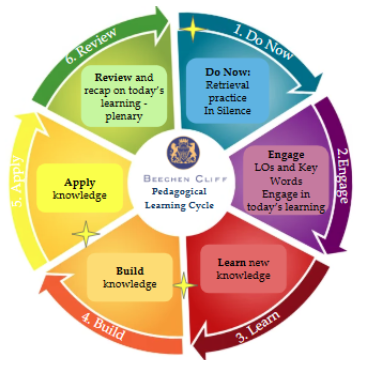
Lessons begin with a ‘Do Now’ retrieval task to recall prior knowledge and build long-term memory. We target an 80% success rate on these quizzes, employing cognitive science’s ‘desirable difficulty’ to secure information.
Students then learn, apply, and review new concepts. This structured learning cycle reduces cognitive load and enhances retention through active application.
Where you see a yellow star on the diagram this is a Knowledge check. These are rapid assessments (such as mini-whiteboards, quick quizzes, or whole-class questioning) that occur at key points to check understanding.
Key Stages 3 and 4 (Years 7-11)
Beechen Cliff students are regularly assessed through end of term/unit assessments, which assess what they have learnt in the scheme of learning they have just completed.
Exams
To ensure that students are assessed on the content they have learned since the beginning of the year or course, all year groups sit end of year exams.
- Years 7-9: Students will sit end of year exams for most subjects in Terms 5 (Yr7/8) and Term 6 (Yr9)
- Year 10: Students will sit full length exam papers for each of their subjects in Term 6 of Year 10. Most of these will be conducted in formal exam conditions.
- Year 11: Students will sit full length mock exam papers for each of their subjects in November and February/March of Year 11. These are also undertaken in formal exam conditions.
This approach allows students to stagger or chunk their revision throughout the year, as well as gaining valuable practice in preparing for larger, end of year exams in preparation for their GCSEs in Year 11.
Preparing for Assessments and Exams
Students are supported in preparing for their assessments and exams in the following ways:
- Revision lessons in subjects
- Personalised Learning Checklists (detailing what students need to revise) and Topic Review Sheets, so that students can get caught up on any work they have missed
- Revision fortnights in the lead up to exams, where all homework set will be revision for the subjects setting exams
- Regular knowledge retrieval quizzes in ‘Do Now’ tasks at the start of lessons
- Lessons on revision skills and coping with exam stress in PSHE
- Tutor time sessions detailing how to revise
- Assemblies in the lead up to Summer Exams
- Revision skills workshops in Year 10 and Year 11
- At KS4, revision guides are recommended by subject teachers
Parents are invited into school to hear about how to support their child/ren’s revision at our Parent Information Evenings.
Homework
Our homework programme is used to further support revision, through regular knowledge tests on platforms such as Seneca and Google Forms, and mid-term learning checks where pupils have the opportunity to apply their knowledge from the term’s learning so far and receive feedback from their teacher ahead of their assessment. In the lead up to assessment and end of year exams, students are set revision tasks as part of their homework to help them to consolidate their knowledge.
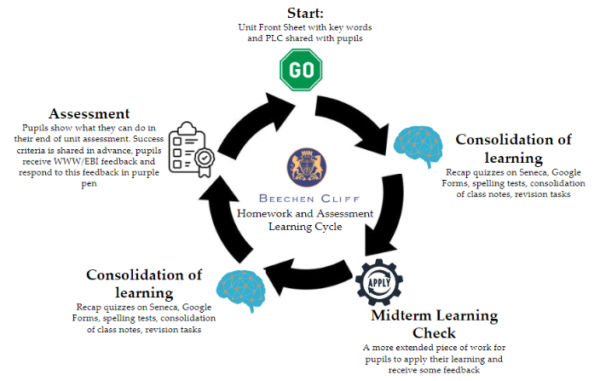
For further support with your child’s revision, please see the resources below.
KS3 Summer Exams Revision Guidance
GCSE Revision Skills workshops
When students are in Year 10 and 11, we run specific, targeted sessions to help them understand how to revise and allow them time to try out some revision methods. We teach students about Ebbinghaus’s ‘forgetting curve’ and the science of learning, so that they understand that forgetting things is normal, and the best way to combat this is to revisit information regularly, and to do something with it! We talk students through our ‘5 Steps to Revise’, and share various methods of how to consolidate their notes, e.g. the Cornell note method, mindmaps, flash cards and flow charts. Students have some time to try out some of these methods and to begin writing their revision timetables in the lead up to their mocks or real exams. Finally, we cover wellbeing during revision and exam periods and signpost students to helpful resources to help look after themselves during what can be a stressful time for them.
Year 11 Revision Skills Workshop – Foundation
Year 11 Revision Skills Workshop – Higher
KS5 (Years 12 and 13)
In the Sixth Form, students are supported in their revision in the following ways:
- The Learning Cycle is in place in all lessons (please see information above)
- Do Now knowledge retrieval tasks in every lesson
- 9th/10th hour curriculum lessons are independent revision and consolidation tasks directed by subject teachers
- ‘How to Revise [Subject]’ documents
- Academic mentoring programme
- Revision Packs for students
- Revision sessions in tutor time and PSHE
- Exam prep and science of learning assemblies – Managing time
- PLCs in the lead up to assessments
- Additional revision sessions led by subject teachers in the lead up to exams
Students in the Sixth Form sit end of unit assessments twice a term (1 per teacher and/or unit), as well as more formalised exams (testing a broader range of content) in January of Year 12 (Mid Year Exams), June of Year 12 (Summer Exams), and formal mock exams in November and March of Year 13.